


Doctoral researchers take over a lot of responsibilities. For their own research, for time management, communication with their supervisors, cooperations in the working group, publications, documentation and much more. Where do my responsibilities begin and end, who has which understanding of responsibility for what and how do I address this? At Research School’s Science College in July, doctoral researchers from all disciplines discussed the topic of own responsibilities with experienced researchers of RUB.
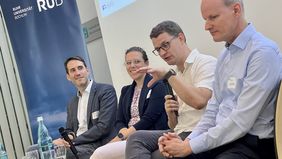
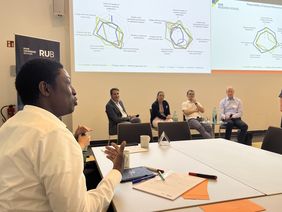
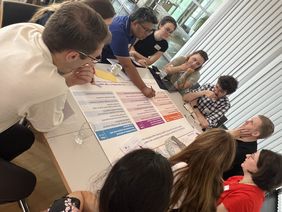
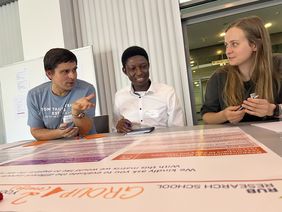
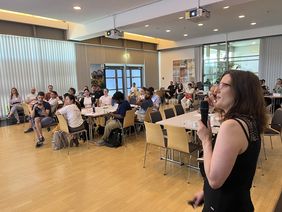
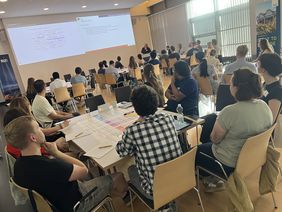
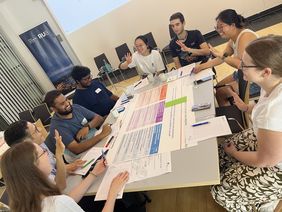
Right at the beginning of the event, Dr. Ursula Justus - coordinator and event organiser at Research School - outlines the challenge doctoral researchers might face: responsibilities, their implementation and distribution are highly individual and often implicit. “We do not have a defined list or framework of responsibilities or how they should be performed. What we have to understand is that this is one of the most challenging things. Expectations have to be clarified between the roles”, says Dr. Justus. She points out: “We cannot define what is always right, but we would like to discuss.” In a hands-on group activity, nearly 40 doctoral researchers used a matrix to assess the extent to which they see themselves or their supervisors as responsible for various topics. During an open panel discussion, the results are then compared with the assessments of experienced researchers from RUB: Jun.-Prof. Dr. Maria Marquardsen (Law), Prof. Dr. Andreas Lammer (Philology), Prof. Dr. Peter Mark (Civil and Environmental Engineering) and Prof. Dr. Ulf-Peter Apfel (Chemistry) share their experiences and perspectives.
The relationship with supervisors has also been discussed. Who is responsible to what extent for regular and successful communication, a structured process, feedback and reflection on the doctorate? Dr. Ursula Justus specifically addresses the panel: “In the beginning, do you communicate to your doctoral candidates how supervision will take place?” Prof. Dr. Ulf-Peter Apfel shares his understanding: “In the end, doctoral researchers should solve problems on their own for the first time, but it’s my responsibility to guide them, challenge them, because that helps develop your research. A supervisor has to have time for you and your issues. I always work with a clear timeline schedule, with breaks and publications, that form the research track.” Prof. Dr. Maria Marquardsen advises: “In the beginning of your doctorate, talk about what one is expecting from one another. You are winning or losing as a team! I’m trying to understand where doctoral researchers come from and what they need to achieve goals.” Ulf-Peter Apfel adds: “We need clear minds to do the work, so we as supervisors should create an environment people can do their best in.”
In the last part of the Science College program, the topic is addressed once again in the Q&A session “How can I contribute to navigate my supervisory relationships?” with Prof. Dr. Wolfgang Schuhmann, Member of Ombudspersons for Good Scientific Practice & former Chair of Analytical Chemistry RUB.
Before that, there was a deep dive into another important area of responsibility: In a focus session on the topic “Who owns the data - rights, responsibilities and research data in Germany”, a team from the University Library Research Data Services explained the legal frameworks, agreements and policies, ethics and where to get help concerning all questions on research data. Using real case studies from all disciplines, the participating doctoral researchers discussed questions like: Who is allowed to do what with my research data? Who may use, publish or license it? “Make it a documented part of your research”, advises Dr. Marlene Pacharra from the Research Data Services team at RUB, “think about this early and check your contracts.”
The Science College takes place annually on changing topics. More information on the event can be found here.
Text & Photos: Raphaela Schade, RUB Research School