


Collective Identity in Ezra/Nehemiah and Ruth
The Research Project

My Ph.D. project concerns the question of how collective identity and boundaries between social groups were constructed through the texts of Ruth and Ezra-Nehemiah in the Second Temple period. Ruth and Ezra-Nehemiah are books of the Hebrew Bible (Altes Testament) that are dated in the Second Temple period. This period in Jehud (516-70 BCE) was deeply influenced by identity conflicts.
Due to the exile policies of the Babylonians, the Judean upper class and skilled workers were deported to different places in the heartland of Babylon after the fall of Jerusalem and after ensuing uprisings in Jerusalem (598/7 BCE, 587/6 BCE; 582 BCE). The Judean exiles formed their new identity and created new identity markers like circumcision and Shabbat. After the capture of Babylon by the Persians (539 BCE) power relations shifted and the Judean exiles were allowed to return. The Second Temple period began. In the perspective of the book Ezra-Nehemiah, the former exiles caused a restoration and enforced not only the rebuilding of the temple and wall of Jerusalem but also a rigid demarcation from other social groups in Jehud. However, this is not the only position during in that historical context concerning boundary work. The book Ruth offers another model. In this book, Ruth, a foreign wife, demonstrates loyalty towards Naomi, a Judaic woman, and therefore is integrated into the heart of Judaic society. Both books deal with the question of boundary work and therefore contribute to the construction of collective identity.
My focus will be on the question of how collective identity is actively produced through the texts and on the function of the figures, their characters, speeches, and acts in the process of identity formation. Certainly, the situations and interactions within the text do not mirror the situation of the emergence of the texts. However, the construction of the situation and interactions offers insights into how the authors imagined the ideal process of building a collective identity and how they tried to construct boundaries through these texts.
What I need the IRB for
The IRB gives me the opportunity to expand my knowledge and enlarge my networks of scholars working on the same topics or with similar approaches. It allows me to evolve my work through discussing it and gaining knowledge at conferences or during research visits.
Moreover, the IRB grant guarantees me a certain flexibility. As I am at the beginning of my Ph.D. work and since my project combines different methods and disciplines, the main focus could still shift in different directions. Through the grant, I gain the flexibility to adjust my plans of internationalization according to the state of my project.
IRB funded activities
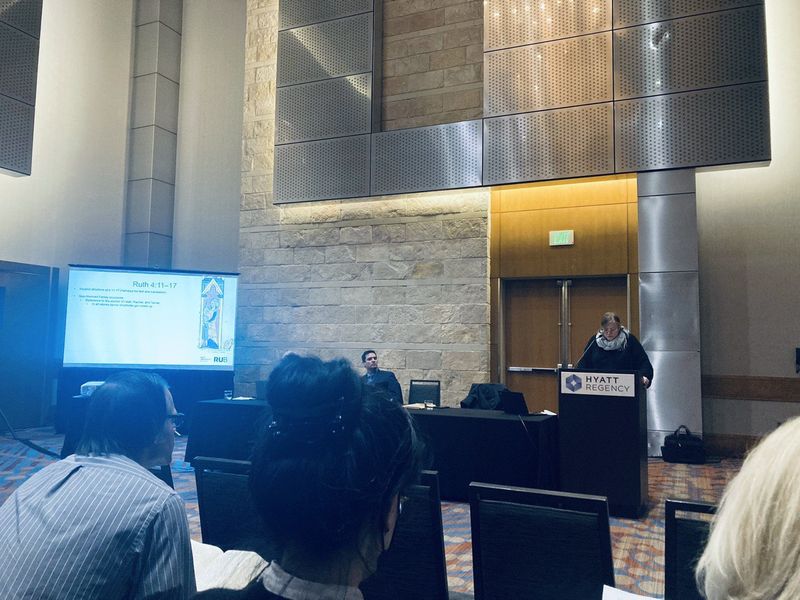
Annual Meeting of the Society for Biblical Literature (November 2022)
I visited this year’s Annual Meeting of the Society for Biblical Literature (SBL) in Denver, Colorado, from November 19th-22nd. This annual meeting is one of largest conferences in our field. I presented a paper on the impact of forced migration on family structures in Ruth 4,11-17; and I also got in touch with many scholars working on topics close to my own. The lectures and especially the discussions afterwards and during the breaks were very enlightening. I am very grateful for the IRB that made it possible for me to present at SBL and meeting and connecting with all the scholars internationally. Hopefully, attending this conference leads to more fruitful discussions via E-Mail and Zoom.
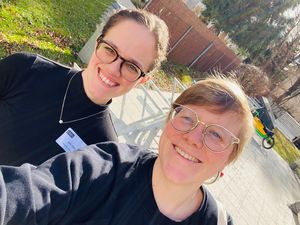
EABS Annual Graduate Symposium, Graz (February 2024)
This February I presented a paper at the 16th EABS Annual Graduate Symposium that took place from the 21st to the 23rd of February in Graz. This is a conference for Ph.D. candidates and postdoctoral researchers organized by the European Association of Biblical Studies (EABS). My paper dealt with the use of emotive language in Ezra 9,1-5+10,1, and its possible intentions. I was thankful for the opportunity and the very fruitful discussion after my paper. Due to the concept of the conference, the participants had several opportunities to meet and hold conversations in the evenings, and on the last day. Therefore, I was able to connect with other Ph.D. candidates and postdoctoral researchers from all over Europe, which was a valuable experience.

EABS Annual Conference 2024, Sofia University, Bulgaria (July 2024)
The European Association of Biblical Studies is one of the largest and most interdisciplinary societies of Biblical Studies. Therefore, a variety of specialized interests can be covered at the annual conference. I presented a paper about the role of emotions and emotive language in building collective identity in Ezr 9–10 and Neh 13:23–31 in a session about emotions and the use of emotions in biblical texts. It was really beneficial getting into conversations with international scholars interested in the same approaches as me. Moreover, I was able to meet scholars from all over the world, reconnect with those I have already met, deepen these relationships, and discuss the progress of my work and its new aspects.

International Meeting of the Society of Biblical Literature (SBL), Uppsala, Schweden (une 23 to 27, 2025)
In my field two of the most important research networks are the Society of Biblical Literature (SBL) and the European Association of Biblical Studies (EABS). This year the annual meeting of the European Association of Biblical Studies (EABS) and the International Meeting of the Society of Biblical Literature (SBL) was a joint conference. From June 23 to 27, 2025, I had the opportunity to participate in this joint conference in Uppsala. Due to the collaboration of both organizations, the event was particularly well attended, international and diverse.
During the conference, I presented a paper on the chapter 2 of the Nehemiah book and the question whether the main figure of this book, Nehemiah, could count as lonely hero (“Nehemiah, a lonely hero?”). In my talk, I critically examined the assumption of heroes as isolated and therefore lonely. Instead of identifying Nehemiah as lonely, I pointed out a collective loneliness as a prevailing mood in the text which affects the figure Nehemiah as well. In addition to the many enriching lectures, the conference offered numerous opportunities for academic exchange. I was able to deepen existing contacts from previous years, and to establish new networks. Moreover, I could share the progress of my PhD-project in general with scholars of the same research interest and received qualitative feedback that will have a great impact on my project.

Research Visit Stellenbosch University, South Africa (April 2026)
Through the IRB I had the opportunity to have a research visit at the Theological Faculty of the Stellenbosch University in South Africa in April 2026. From 07.04. to 24.04.2026, I was able to engage in several academic activities. I attended the weekly research seminar in Hebrew Bible and a joined session together with the New Testament scholars of the University which provided me with valuable insights into ongoing research and scholarly discussions in Stellenbosch.
One of the highlights of my stay was presenting a paper on Nehemiah 1 and its hinge functions within and beyond the Ezra-Nehemiah book. The discussion about possible earlier versions of the Ezra and Nehemiah material and the question of oral and written transmissions of traditions and narratives, provided me with constructive feedback.
I was also able to visit a master seminar to get practical insights how teaching Hebrew Bible in Stellenbosch look like.
Besides that, I had productive conversations with Prof. Dr. Louis Jonker, focusing on the redaction history of Ezra-Nehemiah. Our discussions delved into topics such as the role of the Levites and the dating of texts that mention the Levites in Ezra-Nehemiah. These exchanges were particularly enlightening and helped clarify many aspects of the redactional process.
Apart from the seminars and discussions, I spent a significant amount of time in the library, conducting research and working on my PHD.
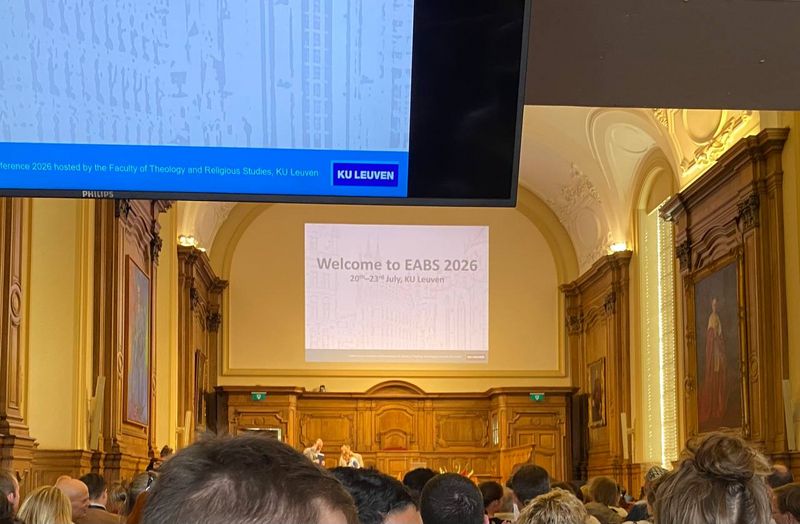
Annual conference of EABS, Leuven, Belgien (July 2026)
From 20th to 23rd July 2026, I visited the annual conference of EABS in Leuven. Together with Prof. Dr. Marievonne Schöttner from the Catholic University of Eichstätt-Ingolstadt, I organized a workshop about “Strategies of Collective Identity Construction in Biblical Texts.” As my PhD is about the construction of collective identity formations in Ezra-Nehemiah, this workshop enriched my own work. I was able to discuss other approaches and other phenomena of identity construction. Finding connections and common threads throughout the papers from scholars of different backgrounds was not only interesting but also broadened my view on the texts and the question of collective identity constructions. Therefore, I am thankful for having the opportunity to co-organize that workshop and work with the different scholars presenting in it.