


Research Communication Day
Exploring the Range of Research Communication


Talks, publications, interdisciplinary research networks, personal websites, (social) media or cooperations with non-university partners: There are many ways and options to communicate your research. Together with experienced researchers and experts you will discuss a broader understanding of research communication. You will explore why and how integrating highly specialized research knowledge into effective communication strategies might be important – within academia and beyond.
Panel discussions, short expert inputs and interactive sessions will allow you to reflect and further develop your own research communication strategy. You can advance your understanding on how to disseminate your complex research ideas as best as possible.
Takeaways for your own research communication
Researchers from various disciplines of RUB share their knowledge and experiences on why and how they communicate their research – from highly specified expert communities to science communication beyond academia. They explain approaches for different aims and target-groups and the experiences they made. They will discuss with you if and why a broader range of communication had an impact for them being successful and visible in research. In the afternoon session you will share your research project with peers from other disciplines.
Join for RS Certificate: If you are interested in the Research School Certificate, participation in Research Communication Day is required once during your doctorate.
Research Communication Day 2026: Friday, 08.05.2026, 09:30 - 15:30 h
What last year's participants liked
How different approaches are in the research of other disciplines and how new perspectives and critical views can emerge through interdisciplinary exchange.
Science communication is not only Science Slams or a talk at a conference, there are more facettes that need appropriate communication strategies.
I also liked the panel discussion with the input and experiences from the researchers.
The opportunity to talk with others about their work from very different fields
Idea
The event is planned interactively: the invited researchers share their knowledge and experiences. You can bring in your understandings and opinions by real-time online votings and we would like to invite you to bring all your questions to discuss them with researchers and peers.
Please download the programme here: PROGRAMME
We present the participating researchers with their profiles and expertise in the neighbouring tab "Participating Researchers" instead of in the programme.
Event Location RUB Centre for City Futures, Blue Square
Kortumstraße 90, 44787 Bochum: Visual Map and directions
We highly appreciate the engagement, many thanks for helping us:
Anna Kira Hippert:
Religious Studies (RUB): doctoral research on new religious movements in Germany and the USA; communicating her research through a video blog and on Instagram; recent publication on science communication and YouTube vlogs.
Dr. Valentina Nachtigall:
Educational Psychology and Educational Technology, Institute of Education (RUB): research on authentic learning, immersive learning, learning in out-of-school labs, productive failure but also on science communication and student beliefs about scientists; responsible member of the Postdoclab Working Group “Artificially Intelligent Communication of Science” of the UARuhr College for Social Sciences and Humanities.
Dr. Merita Tafili:
Soil Mechanics, Foundation Engineering and Environmental Geotechnics, Mechanical Engineering (RUB) & Head of Emmy Noether-Group: research on constitutive models for soils, soil improvement and soil behavior, artificial intelligence in geotechnical engineering; highly experienced in cooperating with researchers from other research fields and partners from outside academia.
Dr. Vanessa Reinhart
Bochum Urban Climate Lab, Institute of Geography (RUB): research on climate adaptation, urban climate, remote sensing, GIS, climate change communication; responsible for scientific dissemination and public outreach in the research project “Data2Resilience”.
Sven-Daniel Gettys (about:stories):
Expert, communication trainer and coach for storytelling, science communication, pitch training and cross-media content production (film, podcast, social media); many years of experience in supporting and coaching researchers to communicate their knowledge publicly; he shares his knowledge in his own podcast, on social media and in videos.
We highly appreciate your participation in the complete programme. If you would like your participation in the Research Communication Day acknowledged for RS Certificate participation in the complete programme is needed.
You are most welcome to register until 04.05.2026: REGISTRATION
Please fill out the following Post-it by summarizing your research project in 2-3 easy-to-understand sentences. Please bring your completed and printed Post-it to the event.
We will need it for the Post-it session in the afternoon.
Research Communication Day 2025
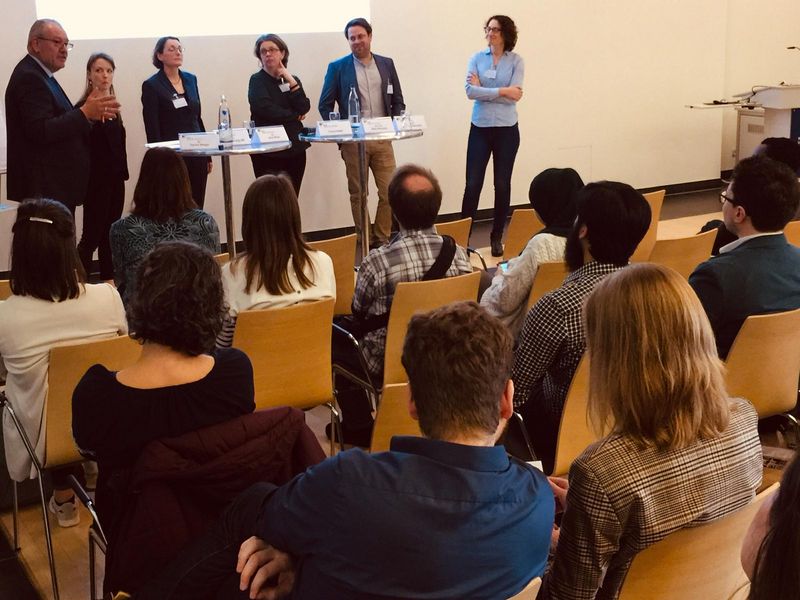
From Geosciences over Sociology of Religion to Criminology: The range of disciplines represented by the experts on the panel at the Research Communication Day illustrated the scale on which research communication is realized by individual researchers.
The guiding question for the discussion was how communication of own research can be adapted, e.g. regarding possible audiences such as experts in the own field, interdisciplinary communities, non-university experts, the public.
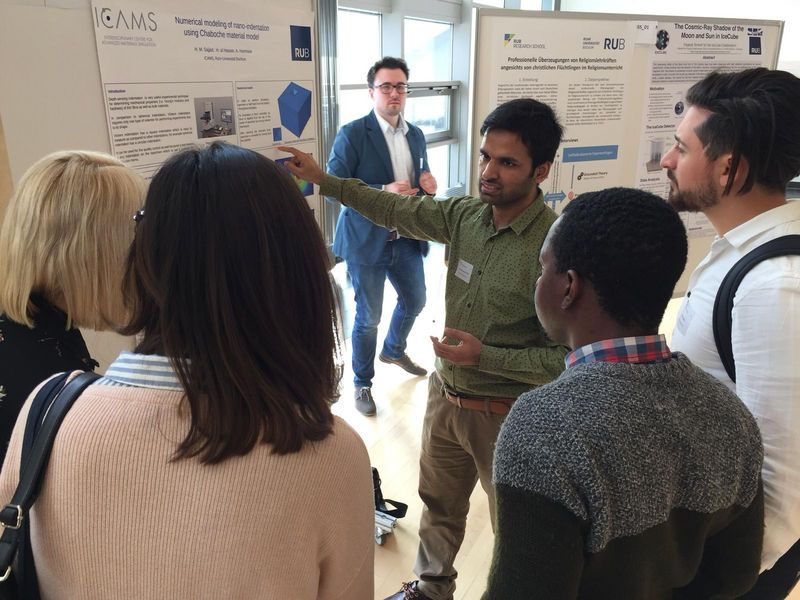
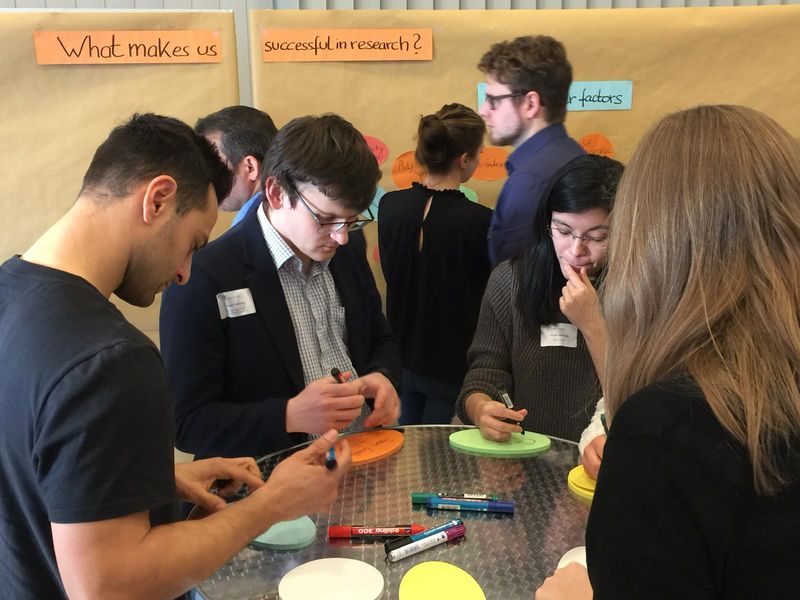
The panelists contributed own case studies, practical knowledge and personal views. Many thanks for the valuable insights to Dr. Dilek A. Tepeli, Jun.-Prof. Dr. Sebastian Golla, Dr. Andreas Sieß, Dr. Maren Freudenberg, Prof. Dr. Valentin Klaus and Paula Weitz. And to all participating doctoral researchers for the willingness to present and discuss your projects in the post-it sessions. Here you will find a report and here the programme.
Resaerch Communication Day 2024
The event adopted a broad perspective, discussing the range of research communication, from specialized expert communities to science communication beyond academia. It compared and contrasted different modes and strategies of research communication, focusing on the ability to “scale” communication without delving into the specifics of each method. The event was designed to be interactive, encouraging participants to share their knowledge and experiences, and fostering interdisciplinary dialogue.
Key topics included the development of communication strategies over time, the navigation of communication modes, the effectiveness of research communication, and the impact of diversified communication strategies on research visibility. The event also explored the responsibility of researchers to share their work beyond expert communities and discussed recent developments in research communication. The event provided a valuable opportunity for doctoral researchers to enhance their research communication skills and to network with peers from diverse disciplines. You can find the programme here.
Research Communication Day 2023
The event aimed to raise awareness among doctoral researchers about the importance of research communication skills and to help them develop a diversified understanding of effective research communication. It explored the impact of communication behaviors and strategies on research visibility and success.
The first part focused on scaling communication in research, with sessions on communicating within close and interdisciplinary communities, and beyond academia. These sessions included interactive parts, expert examples, and panel discussions, covering topics such as understanding “research language,” the role of researchers’ identities and values, and strategies for communicating with non-researchers.
The second part focused on online research communication, including interactive sessions, a video on science communication in social media, expert input, and panel discussions. Topics covered the pros and cons of sharing research in social media, trends in online communication, and the role of researchers’ identities online.
The event concluded with a post-it session where participants shared information about their projects and researcher identities, fostering interdisciplinary networking. You can find the programme here.
Research Day 2020: Communicating research beyond (disciplinary) borders, 13 February 2020
The event focussed on explaining research to an interdisciplinary community or to the general public. It supported the participants in understanding and reflecting how to communicate their research beyond their research field or even beyond academic borders. In a panel discussion experts and experienced researchers from RUB shared their experiences about why and how to communicate research to a wider community or public actors. In Mini-Workshops experts offered state-of-the-art and alternative formats supporting the participants to start working on strategies to communicate their research beyond borders: sketching a graphically recorded poster, gamestorming with e.g. Lego or Playmobil and developing an elevator pitch. The programme closed by a “Post-It” session to which the participants brought a Post-It summing up their research in one sentence. During the Post-It session they presented their research project to participants from completely different research fields. You can find the programme here.
Research Day 2019: Requirements and Attitudes for a Successful Research Career, 28 February 2019
The morning programme addressed both: the most important factors for a research career and the personal attitudes that make researchers successful. The participants discussed with invited experts the established and distinct criteria for a research career and reflected their meaning and impact for appointment procedures of university chairs. The participants specially discussed with experienced Postdocs personal career attitudes and experiences. In the second part of the day the participants introduced and proposed their own research project in an interdisciplinary poster session with doctoral researchers from different research fields. In an interactive part at the end of the programme they reflected the question if, why and how to describe the meaning of their research related to broader societal questions. You can find the programme here.
Research Day 2017: Career factors for your research career and communication of your research beyond disciplinary borders, 9 November 2017
This event addressed the most important personal factors for a research career. Established postdocs shared their experiences and career strategies on developing individual research profiles, building research reputation, raising third-party funding, working on international visibility, developing teaching portfolios and shaping personal skills. They explained how they deal with personal challenges and decisions to build a successful research career. The participants could bring in their career knowledge in interactive parts and discussed their career perspectives. A plenary table on different career options in research closed the morning session. In the second part of the day the participants discussed their own research projects in an interdisciplinary setting. They started with poster sessions in interdisciplinary groups, followed by an expert input giving tips and strategies to explain research to non-experts and a practical exercise in re-designing posters to communicate their research to non-experts. You can find the programme here.
Research Day 2016: Academic Profile and Effective Communication, 14 November 2016
The first half of the day addressed postdoc career options by providing strategic information on how to start and consolidate a research postdoc career. The second half of the day has been dedicated to exchanging about the research projects of the participants within and beyond disciplinary boundaries and to analyzing the importance of communication in research. The first half of the day started with an expert input and interactive discussions about strategic issues and essential skills to become a successful independent researcher. Successful Postdocs shared their experiences and gave tips and recommendations on career building strategies. In the second part of the day an expert panel of experienced researchers of RUB discussed about the relevance of subject specific and non-subjects specific communication in research. Recent interdisciplinary graduate schools of the RUB exemplified how communication cross disciplines work and effects joint research projects. The day closed by interdisciplinary poster sessions supporting the participants to exchange with researchers from within their field and from very different research fields to start a dialogue cross disciplines. You can find the programme here.
Research Day 2015: International Aspects of an Academic Career, 19 November 2015
You can find the programme here.
Research Day 2014: Developing a successful profile for an academic career, 6 November 2014
You can find the programme here.
Research Day 2013: Research Takeway - Get tips and hints for a successful research career!
You can find the programme here.
Research Day 2012: Working in Research – Perspectives for Post-Docs, 21 November 2012
You can find the programme here.
Research Day 2011: InterDisciplinary Research, 10 November 2011
You can find the programme here.
During the first 4 years doctoral researchers from the three sections Humanities & Social Sciences, Life Sciences and Natural & Engineering Sciences organised a section day as a one-day research conference for each section. The programme combined lectures on recent research topics by experienced researchers with presentations of research projects of doctoral researchers. Encouraged by these experiences and the strong interest of the doctoral researchers in a scientific exchange beyond disciplinary borders the concept has been changed to organising a one-day meeting for doctoral researchers from all sections, transforming the "Section Days" into the “Research Day”.
Section Days 2010, 3-5 November 2010
Natural Sciences and Engineering: “Nanotechnology”
Life Sciences: “Communication”
Humanities and Social Sciences: “Borders – Conflicts - Innovations”
You can find the programme here.
Section Days 2009, November 4-6, 2009
Humanities and Social Sciences: “The Archaeology of Science and Knowledge”
Life Sciences: “The Art of Nature”
Natural Sciences and Engineering: “Functional Materials”
You can find the programme here.
Section Days 2008, 5-7 November 2008
Life Sciences: “Signal Transduction and its Medical Relevance”
Natural Sciences and Engineering: “Surface Science and Engineering”
Humanities and Social Sciences: “Narration/Mediation: The constitution of the ‘Self’ in interdisciplinary perspective”
You can find the programme here.
Section Days 2007, 5-7 November 2007
You can find the programme here.
To let you know:
We offer the event in English to integrate all research areas and research languages on campus.
Listen to how AI describes the event
Getting to know each other
How a chance encounter at Research Communication Day 2023 gave rise to an interdisciplinary reading group at RUB.
Your contact:
